
Oral Probiotics for Tonsil Stones: Can They Help Reduce Debris and Bad Breath Naturally?
Do you constantly feel an irritating lump at the back of your throat — or occasionally cough up small, foul-smelling white pieces?
If so, you may be dealing with tonsil stones, also known as tonsilloliths.
For many people, the problem goes beyond the stones themselves. There is the unpleasant taste, persistent throat discomfort, and perhaps the biggest concern of all: bad breath that seems impossible to get rid of.
It is frustrating. You brush your teeth, clean your tongue, gargle, and remove the visible debris — only to have the problem return.
But what if the solution isn’t simply about removing what you can see?
The environment inside your mouth matters too.
Your oral cavity is home to hundreds of different types of microorganisms. Some are beneficial, while others can contribute to plaque, unpleasant odors, and the production of volatile sulfur compounds (VSCs) associated with bad breath.
This is where oral probiotics are attracting growing interest.
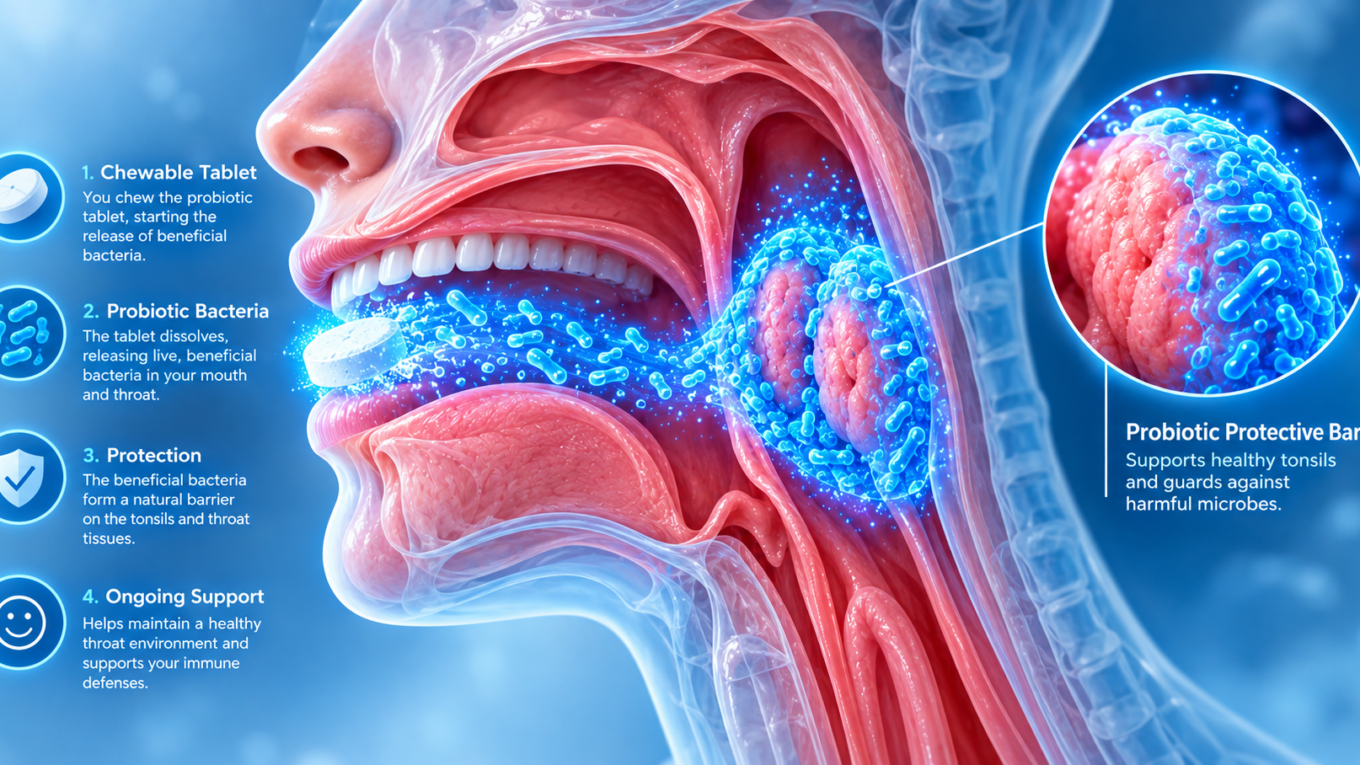
Rather than trying to eliminate every microorganism in your mouth, targeted oral probiotics are designed to support a healthier microbial balance by introducing beneficial bacteria directly into the oral environment.
What Are Tonsil Stones and Why Do They Keep Coming Back?
Key Takeaway
Tonsil stones form when material such as food particles, mucus, bacteria, and dead cells becomes trapped inside the natural crypts and crevices of the tonsils.
Your tonsils aren’t completely smooth.
They contain small folds and pockets called tonsillar crypts. These crypts can naturally collect microscopic debris.
Over time, this material can become compacted and form small white or yellowish deposits.
The problem becomes even more frustrating when bacteria interact with the trapped organic material.
Certain bacteria can break down proteins and other compounds, contributing to the production of volatile sulfur compounds — chemicals strongly associated with unpleasant breath.
That’s one reason tonsil stones can smell so bad.
Removing the Stone Doesn’t Necessarily Address the Environment
Manually removing a tonsil stone may solve the immediate problem.
But if the underlying environment inside the mouth remains unchanged, new debris can potentially accumulate again.
Think of it like pulling weeds from a garden.
Removing the visible weed helps, but it doesn’t necessarily change the conditions that allowed it to grow in the first place.
This is why oral hygiene and the balance of microorganisms in your mouth are worth paying attention to.
Can Oral Probiotics Help With Tonsil Stones?
This is where the approach becomes interesting.
Oral probiotics are not a guaranteed cure for tonsil stones, and there is not enough clinical evidence to claim that they can permanently prevent or eliminate tonsilloliths.
However, research into oral probiotics has shown potential benefits for oral microbiome balance and bad breath, particularly with certain probiotic strains.
Instead of attempting to eliminate all bacteria, oral probiotics introduce selected beneficial microorganisms that may compete with undesirable bacteria and influence the microbial environment.
For someone dealing with recurring throat odor or bad breath associated with tonsil stones, that makes oral probiotics an interesting addition to a daily oral-health routine.
Here are some of the ways they may help support the oral environment.
1. Supporting a Healthier Microbial Balance
Your mouth is an ecosystem.
The goal isn’t to eliminate every bacterium — that’s neither realistic nor desirable.
The goal is to maintain a healthier balance between the microorganisms living in your oral cavity.
Certain beneficial probiotic strains may compete with undesirable bacteria for nutrients and attachment sites.
By supporting beneficial bacteria, oral probiotics may help create an environment that is less favorable to some odor-associated microorganisms.
2. Helping Reduce Odor-Associated Bacteria
One of the biggest concerns with tonsil stones isn’t necessarily their appearance.
It’s the smell.
Certain oral bacteria can contribute to the production of volatile sulfur compounds, which are responsible for much of the characteristic odor associated with halitosis.
Specific oral probiotic strains, including Streptococcus salivarius K12, have been investigated for their potential role in supporting oral health and reducing unpleasant breath.
Rather than simply masking the smell with a minty rinse, the goal of an oral probiotic approach is to support the microbial environment that contributes to odor in the first place.
That difference matters.
3. Supporting a Healthier Oral Environment
Constantly poking, scraping, or aggressively manipulating the tonsils can leave the surrounding tissue irritated.
Good oral hygiene remains important, but the goal should be to care for your mouth without unnecessarily disrupting its natural microbial environment.
An oral probiotic can be used as part of a broader routine designed to support oral microbiome balance.
It isn’t a replacement for brushing, flossing, tongue cleaning, or professional dental or medical care.
Instead, it can complement those habits.
Why Oral Delivery May Matter
A common mistake is assuming that every probiotic product works the same way.
It doesn’t.
Many conventional probiotics are formulated primarily for the digestive tract. They are swallowed and designed to deliver microorganisms further down the gastrointestinal system.
Oral probiotics are different in their intended use.
A chewable tablet or dissolving lozenge allows the probiotic microorganisms to remain in the mouth and mix with saliva before being swallowed.
This gives the selected strains more direct contact with the oral environment.
For people specifically interested in supporting their oral microbiome, breath, gums, and throat environment, that direct oral exposure can be an important consideration when choosing a probiotic.
The Simple Routine to Support Your Oral Microbiome
You don’t need a complicated routine.
A consistent approach can be surprisingly simple.
1. Brush Your Teeth Normally
Brush twice a day using proper brushing technique.
Pay particular attention to the gumline.
2. Clean Between Your Teeth
Floss or use another appropriate interdental cleaning method to remove food particles that brushing alone cannot reach.
3. Clean Your Tongue
The tongue can harbor significant amounts of bacteria and debris associated with unpleasant breath.
Gentle tongue cleaning can therefore be a useful part of an oral-health routine.
4. Avoid Excessive or Aggressive Rinsing
Not every mouthwash is bad, and mouthwash can have legitimate uses.
However, repeatedly using harsh antimicrobial products isn’t necessarily the best approach for maintaining a balanced oral environment.
Choose your oral-care products thoughtfully.
5. Consider an Oral Probiotic
A chewable or dissolving oral probiotic can be incorporated into your nighttime routine according to the product’s directions.
Allowing the product to dissolve in the mouth gives its probiotic strains an opportunity to interact directly with the oral environment.
Consistency matters more than complicated routines.
Why ProDentim May Be Worth Exploring
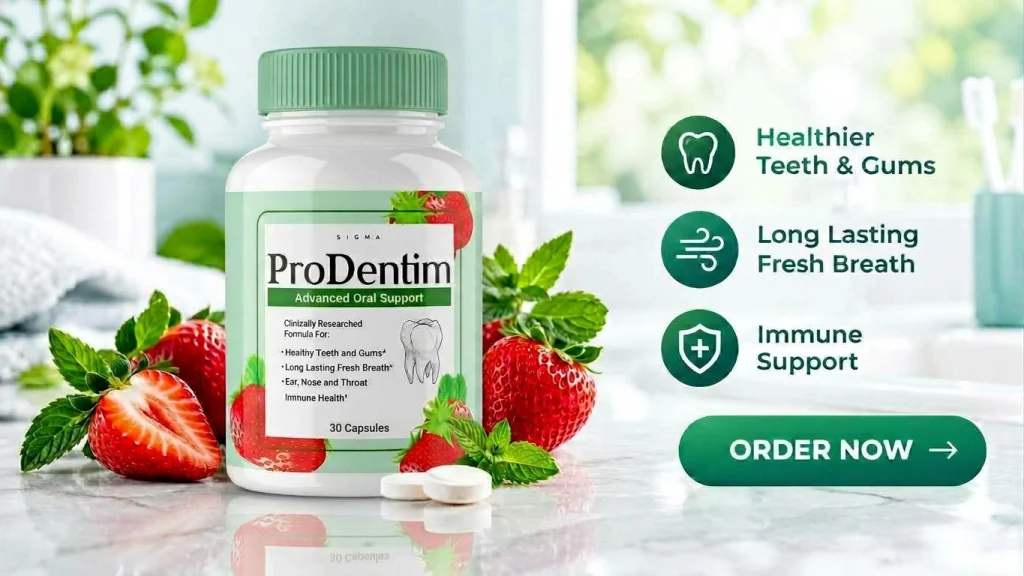
If you’re looking for a convenient way to add an oral probiotic to your daily routine, ProDentim is one option worth exploring. You can also read our full ProDentim review to learn more about the formula, ingredients, and how the chewable probiotic works.
The concept behind an oral probiotic is different from simply using another product to mask bad breath.
Instead of focusing only on the smell, the goal is to support the microbial environment inside the mouth.
That makes oral probiotics particularly interesting for people who are concerned about:
- Persistent bad breath
- Morning breath
- Oral microbiome balance
- Gum and mouth health
- Throat odor
- Recurring tonsil-stone-related discomfort
The important point is that ProDentim should be viewed as part of a broader oral-health routine — not as a guaranteed cure for tonsil stones.
If you’re interested in seeing how the formulation works and whether it fits your needs, you can learn more about ProDentim and its ingredients here.
Can Oral Probiotics Remove Existing Tonsil Stones?
No — oral probiotics should not be considered a proven method for physically removing an existing tonsil stone.
If you already have a visible tonsil stone, appropriate removal may be necessary.
The potential role of oral probiotics is different.
They are designed to support the oral microbial environment and may help with factors associated with unpleasant breath.
In other words:
Removing the stone addresses what you can see. Supporting your oral microbiome addresses the environment around it.
For people who experience recurring tonsil stones or persistent throat symptoms, it is also important to speak with a qualified healthcare professional.

Frequently Asked Questions
Can oral probiotics cure tonsil stones permanently?
There is currently not enough clinical evidence to say that oral probiotics can permanently cure tonsil stones.
However, certain oral probiotic strains have been studied for their potential to support oral microbiome balance and improve measures associated with bad breath.
They may therefore be a useful addition to an overall oral-health routine, but they should not be viewed as a guaranteed cure.
How long does it take for oral probiotics to work?
There is no established timeframe for oral probiotics to eliminate tonsil stones specifically.
Studies investigating oral probiotics and halitosis have evaluated results over periods ranging from several days to several weeks.
Individual results can vary depending on the cause of bad breath, oral hygiene, diet, existing oral conditions, and the specific probiotic strain being used.
The most important factor is consistent use according to the product’s directions.
Are standard gut probiotics effective for throat health?
Not necessarily.
Traditional gut probiotics and oral probiotics can have different intended purposes.
A probiotic designed to be swallowed and delivered primarily to the digestive tract is not the same as a product formulated to dissolve in the mouth.
If your goal is to support the oral microbiome, an oral-delivery probiotic may be a more targeted option.
Can oral probiotics help with bad breath?
Research suggests that certain oral probiotic strains may help reduce factors associated with halitosis, including volatile sulfur compounds.
However, bad breath can have many different causes.
If persistent halitosis continues despite good oral hygiene, it is worth speaking with a dentist or healthcare professional to identify the underlying cause.
Should I stop brushing or flossing if I use an oral probiotic?
Absolutely not.
Oral probiotics should complement — not replace — normal oral hygiene.
Continue brushing, cleaning between your teeth, and cleaning your tongue as part of your regular routine.
When should I see a doctor or dentist about tonsil stones?
Occasional tonsil stones are often not serious.
However, seek professional advice if you experience frequent or persistent tonsil stones, significant throat pain, difficulty swallowing, bleeding, fever, recurrent tonsillitis, persistent bad breath despite good oral hygiene, or unusual swelling of the tonsils.
A dentist, physician, or ENT specialist can help determine whether another condition is contributing to your symptoms.
The Bottom Line
Tonsil stones can be frustrating — especially when they are accompanied by persistent unpleasant breath.
Removing the visible debris may provide temporary relief, but maintaining good oral hygiene and supporting a healthy oral microbial environment can also be important.
Oral probiotics offer a different approach.
Rather than trying to eliminate every microorganism in your mouth, they are designed to introduce beneficial bacteria that may help support a healthier oral microbiome and reduce factors associated with unpleasant breath.
They aren’t a magic cure.
But for someone looking for a simple, targeted addition to their daily oral-care routine, an oral probiotic may be worth considering.
Explore ProDentim and discover how an oral probiotic can fit into your daily routine.
One thought on “Oral Probiotics for Tonsil Stones: Can They Help Reduce Debris and Bad Breath Naturally?”